Begin where the empire is still young and sure of itself. Qin and Han bronze, lacquer, and wide-shouldered stone carry a confidence that needs no ornament — objects of a state finding its edge, bold in outline and unafraid of weight.
By the Tang dynasty the roads are open and the table is generous. Tea enters the literati’s evening, silver catches the lamplight, and sancai glaze spills color across a cosmopolitan age — grandeur worn easily, like breath held wide.
The Song dynasty turns the eye inward. Celadon cools to the color of rain on stone, ink thins to a whisper, and restraint becomes the highest compliment — beauty that asks to be noticed slowly, or not at all.
The Yuan dynasty opens the kilns to a wider world. Blue-and-white appears like a cold wind across a blank page — vast, open, and a little lonely — the color of distance between mountains.
By the Ming dynasty the study grows still. Zisha clay warms in the hand, a faint thread of incense marks the hour, and objects shrink to the scale of a single seated person — plain, durable, meant to be used every day.
The Qing dynasty layers ornament like late autumn — famille rose, cloisonné, and the small extravagance of a snuff bottle. It is not excess for its own sake but patience made visible, craft pushed to the edge of the possible.
The modern Chinese style clears the table and keeps only what is needed. Negative space, unvarnished wood, one honest line — a dynasty measured not in dates but in the breath a room can still hold.
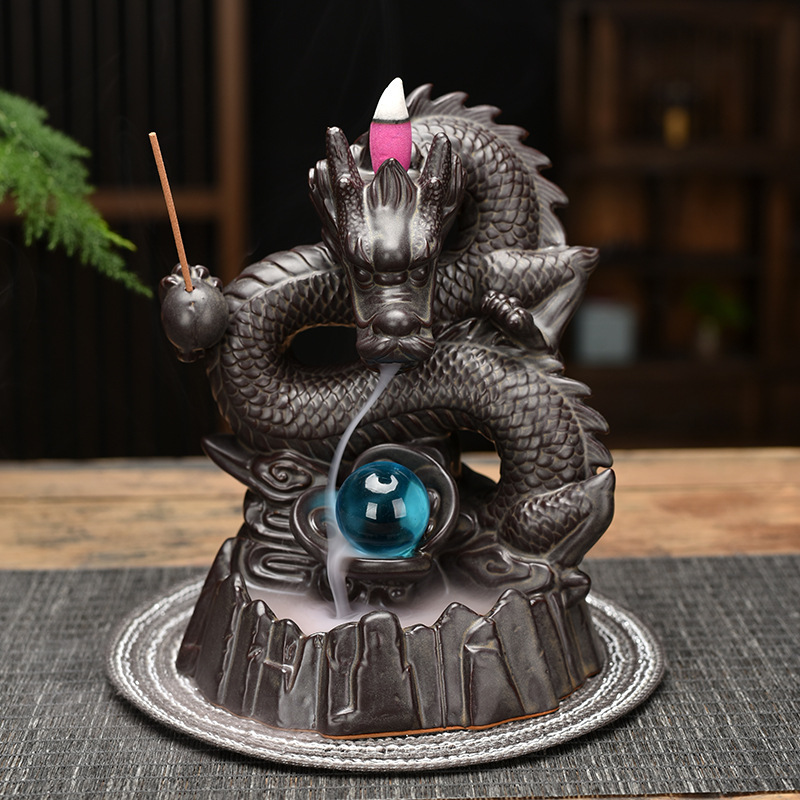
Bringing a dynasty home
Each posture has objects that still carry it. You do not choose a dynasty to live in — you choose the one whose posture your hands recognize.
- Qin–Han confidence — bronze with weight and purpose. An antique-finish bronze burner or a three-legged copper censer holds that first posture: nothing apologetic in the line.
- Song restraint — the color of rain on stone. A celadon tea set or a Song-style tea bowl set turns any morning into that dynasty’s quiet.
- Ming scale — the study sized to one seated person. Zisha clay does it best; this zisha backflow burner is that idea in palm-sized form, plain enough to be used daily.
- Qing patience — ornament as visible craft. An enamel lotus burner carries a measured share of it: color, but at the scale of a desk, not a palace hall.
Which dynasty suits a small apartment?
Song, almost always — and the modern style it taught. Restraint is the only ornament that shrinks gracefully: celadon against plain wood, one object per surface, light doing the decorating. Qing splendor wants a large room to breathe in; Han weight wants a floor that can carry it. A small room run on Song rules feels larger than its walls, because negative space is the one purchase that adds square meters.
How do the dynasties speak to each other?
In reactions. Yuan’s blue-and-white answers Song’s restraint with trade routes; Ming’s plainness answers Yuan’s scale with the single seated reader; Qing’s ornament answers Ming’s austerity with patience. Even the modern style is a reply — to all of them at once. Read that way, the walk is not a museum corridor but a long conversation, and any object you own is a sentence you have chosen to keep saying.
Each dynasty is a posture — the objects are what remain when the posture relaxes.