Light one stick when you close the laptop — not as fragrance for guests, as a boundary you can smell. Classical blends are quieter than perfume; they ask less of the room.
Open a window a finger-width. Place the burner where ash can fall safely. Stay for three breaths after the tip glows. That is enough.
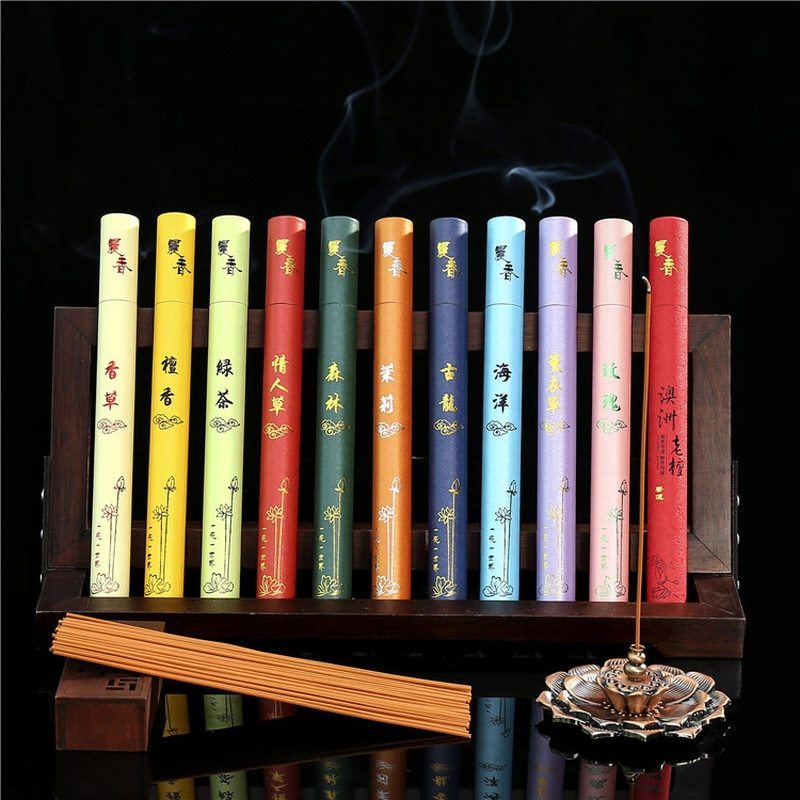
How do you burn incense safely indoors?
Give the stick a stable base, the room one finger-width of airflow, and the ash somewhere honest to land — that covers nearly everything. The rest is placement, not precaution:
- Set the burner on ceramic, wood, or stone — never on paper, fabric, or a shelf that holds books above it.
- Keep a window open a finger-width; a thin thread of smoke moving steadily means the air is moving too.
- Stay for the first three breaths. If the ember glows evenly and the smoke rises in one line, you can leave it.
- Let the stick finish itself. Pinching it early is fine; relighting the same stick tomorrow is also fine.
Which scent should a beginner choose?
Start with sandalwood if you want quiet, agarwood if you want depth, and herbal blends if you want clearing. They are three different registers of the same idea:
- Sandalwood is creamy and low — the default evening note for a reason. Our Australian sandalwood sticks sit in that register, and the classic sandalwood blend is the one we reach for first.
- Agarwood is resinous and dark, closer to wet wood after rain — the Laoshan agarwood blend is an affordable way to learn whether it suits you.
- Herbal and Tibetan blends — mugwort, cedar, juniper — smell green and medicinal, closer to a mountain clinic than a perfumery. The morning–day–night Tibetan set is made to be chosen by hour, which is a gentle way to learn what your evenings want.
What burner suits stick incense — and how long does a stick burn?
A simple holder is honest work: this black walnut stick holder catches ash in a shallow channel and disappears on a desk. If you want the burner itself to be part of the view, a lidded celadon burner with a copper lid softens the smoke to a haze — the way temple courtyards do it.
Burn times, roughly: a standard stick runs 25 to 40 minutes depending on thickness; a coil smolders for close to two hours; a backflow cone spends itself in about ten. Match the length to the evening, not the other way around — ten honest minutes is a complete ritual.
Questions people ask before lighting the first stick
The smoke bothers someone in the house. Now what?
Use a shorter stick, move the burner closer to the window, or step down to a sachet in a drawer — scent without smoke. The ritual is the intention, not the volume of smoke.
How do I store incense so it keeps its scent?
Airtight, dark, and dry — a sealed jar beats the box it came in. Sandalwood holds for years; delicate herbal blends fade within a season, which is a reason to burn them, not to hoard them.
Incense is a soft reset: the air changes before you explain anything.