Negative space is not emptiness for its own sake. It is a place for attention to land. One stem, one rock, one lamp at dusk — the room stops competing with you.
Change the stem with the season if you like. Or keep the same dry branch for a month. Constancy can be as calming as novelty.
How do you arrange a single stem?
Give the stem a height of roughly one and a half times the vase, strip everything below the waterline, and let it lean — a single stem arranged is a line drawn, and lines need somewhere to go. If one feels too sparse, the classical counts are odd: three stems read as a triangle, five as a cloud. Even numbers close the composition and the eye stops moving.
- Measure against the vase, not the room — the stem’s height, multiplied by one and a half, is where it wants to end.
- Remove every leaf that would sit under water; they rot first and smell second.
- Cut the stem at an angle under running water so it drinks freely for the week it stands.
- Turn the vase a quarter-turn when you water it. A lean should be seen from all sides.
Where should a one-stem vase stand?
On a clear surface, against a plain wall, at or below eye level — the arrangement works by contrast, and contrast needs emptiness around it. Clear the surface first: mail, chargers, the second coin dish. An ink-wash vase on a crowded desk is furniture; on a cleared one, it is a focal point.
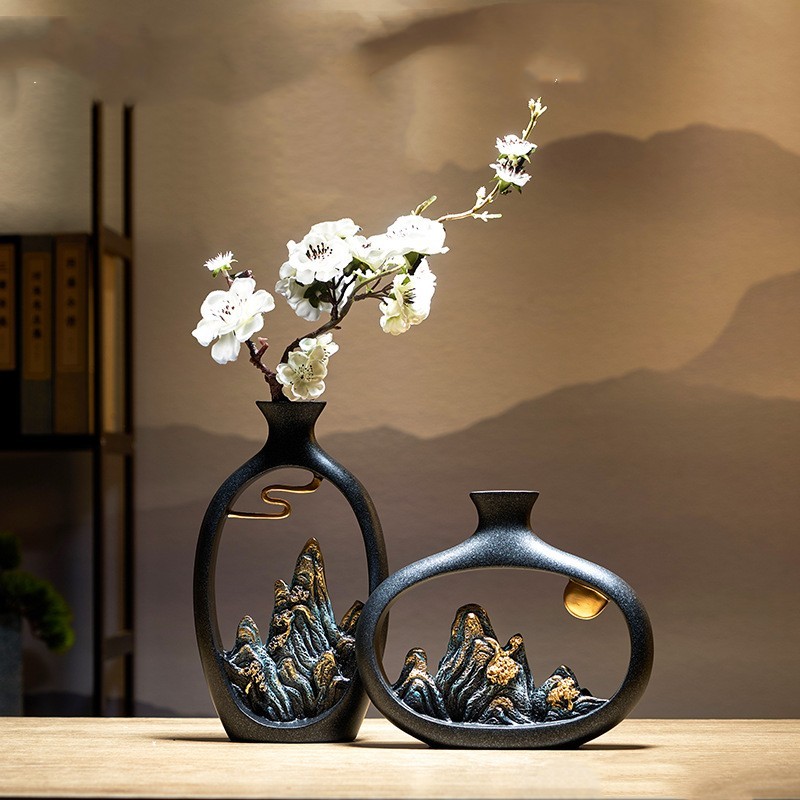
Light matters more than position. A north window gives the flat, even light of a painted scroll; a lamp at dusk gives the stem a shadow worth watching. What it does not want is the middle of a busy wall — give it the margin of the room, the way a painter gives the subject the corner of the paper.
What if you only have dry branches?
Keep them. A dry branch is the lowest-maintenance object in the house — it asks for nothing for months, and its constancy is the point. Fresh stems change weekly and mark the season; a dry branch holds one posture and lets the light around it do the changing. Many quiet rooms are run on nothing else.
Questions about the one-stem room
How often should I change the water?
Every two days for fresh stems, with a fresh angle-cut of the stem at the same time. Dry branches and stones skip this entirely — which is part of their charm.
Can one stem really change a room?
It changes the part of the room your eyes rest on. That is the whole mechanism: attention needs a place to land, and a single line gives it one. Everything else the room does after that is momentum.
One stem is enough. The room will do the rest.
Clear the surface around the vase first. The object only works if the desk is not arguing with it.